• How Much Are Closing Costs for Buyers in Georgia?

    How Much Are Closing Costs for Buyers in Georgia?

    Quick answer (TL;DR)

    Georgia buyer closing costs typically run 2%–5% of the purchase price. On a $300,000 home, that’s roughly $6,000–$15,000 at the closing table, not counting the down payment. Georgia requires a licensed closing attorney for every residential transaction, so that fee is always in the total. Some costs, like lender origination fees, you can shop and compare. Others, like county recording fees, you cannot.

    Closing costs in Georgia typically run 2%–5% of the purchase price. They cover lender fees, title insurance, closing attorney charges, and prepaid items. Georgia requires a licensed attorney for every residential transaction, so attorney fees are a fixed part of every Georgia buyer’s closing disclosure.

    What closing costs actually cover

    Closing costs are the fees and prepaid expenses due at the closing table, separate from your down payment. They cover the services, insurance, and recording fees that make the transaction legally binding. They do not go to the seller.

    Lender FeesOrigination, underwriting, discount points
    Third-Party FeesAppraisal, title insurance, attorney, survey
    Prepaid ItemsInsurance, property taxes, prepaid interest

    Closing costs do not include your down payment, your earnest money deposit (credited back at closing), or post-closing reserves beyond what your lender requires in escrow. It’s easy to conflate these when building a cash-to-close figure, so keep them in separate columns from the start.

    Georgia’s closing attorney requirement

    Georgia is one of a minority of states that requires a licensed attorney to supervise every residential real estate closing. You cannot close on a Georgia home without an attorney present and in charge of the disbursement of funds.

    What the closing attorney does

    The closing attorney performs the title search, resolves any title defects, prepares the warranty deed, coordinates payoff of the seller’s existing mortgage, manages the transfer of funds, and records the deed with the county. They represent the lender by default. If you want independent legal representation as a buyer, you hire a separate attorney; that’s a different engagement at a different cost.

    Attorney fees at a North Georgia closing typically range from $500 to $1,500 depending on transaction complexity and the firm. You can sometimes negotiate which attorney conducts the closing, but you cannot opt out of having one.

    Georgia’s attorney-close requirement means every buyer gets built-in title review before the deed transfers. The attorney’s job is to confirm the deed is clean before funds move.

    Lender fees: what your mortgage company charges

    Lender fees appear in Section A of your Loan Estimate, which your lender is required to provide within three business days of receiving your loan application. These fees vary more than any other closing cost category because lenders price them differently and some are negotiable.

    FeeTypical RangeNotes
    Origination / underwriting fee0.5%–1.5% of loan amount, or flat feeCovers the lender’s processing and underwriting work; structure varies by lender
    Discount points1 point = 1% of loan amountOptional; buys a lower rate. Evaluate the break-even timeline before paying.
    Application / credit report fee$30–$100Small; confirm it’s itemized separately, not buried in the origination line
    Flood certification$10–$30Determines whether the property sits in a FEMA flood zone
    Compare Loan Estimates from at least two lenders

    The Loan Estimate format is standardized by the CFPB, so Section A fees are directly comparable across quotes. A meaningful difference in origination fees on a $300,000 loan can reach several hundred to over a thousand dollars. Rate alone isn’t the full comparison; look at Section A and Section B together before committing.

    Third-party fees: what you pay everyone else

    Third-party fees cover services ordered by the lender but performed by independent companies. Some of these are “shopped” services, meaning your lender gives you a list of approved providers and you can choose among them, sometimes at a lower cost. Others, like the appraisal, are ordered directly by the lender.

    ServiceTypical Range in GeorgiaNotes
    Appraisal$400–$700 for a standard single-family homeOrdered by the lender; rural or acreage properties may run toward the higher end or beyond
    Home inspection$300–$600 (general inspection)Buyer-ordered; budget separately for well, septic, or chimney inspections on rural properties
    Lender’s title insuranceVaries by insurer and loan amountRequired by the lender; protects the lender’s interest in the property
    Owner’s title insuranceOften bundled with lender’s policyOptional but strongly recommended; protects your equity from undiscovered title defects
    Survey$300–$700 if requiredNot always required, but common on rural, acreage, or older properties
    Recording feesVaries by county and page countCollected by the county at deed recording; non-negotiable

    Rural North Georgia properties often add costs suburban buyers don’t encounter. A dedicated well-and-septic inspection typically runs $200–$500 on top of the general inspection, and properties accessed by private roads sometimes require a survey or easement review. If you’re comparing homes in North Georgia under $250,000, the 2%–5% range still applies, but rural-specific inspections sit outside that baseline.

    Prepaid items and escrow deposits

    Prepaid items are not really fees. They’re advance payments on costs you’d owe regardless of when you close. They show up in the cash-to-close total because the lender requires them to fund the loan and establish the escrow account.

    • Prepaid homeowner’s insurance. Most lenders require the first year’s premium paid in full before or at closing, plus two to three months deposited into escrow to cover the next payment cycle.
    • Prepaid interest. Interest accrues from the closing date to the end of that calendar month. A closing on the 5th means you pay roughly 25 days of interest upfront; a closing on the 28th means two or three days. Some buyers choose a late-month closing specifically to reduce this item.
    • Property tax escrow. The lender requires several months of estimated annual taxes deposited to seed the escrow account. The exact number depends on the county’s tax cycle and when taxes are next due. Your Closing Disclosure shows the specific amount.
    Escrow deposits are your money, not a lender fee

    Funds in your escrow account are held by the lender to pay taxes and insurance as bills come due. The remaining balance is returned when you sell, refinance, or pay off the loan. These deposits inflate the cash-to-close figure significantly, but they’re not a cost. They’re advance-funded expenses.

    How to lower your closing costs in Georgia

    Some closing costs are fixed: county recording fees are set by the county, and the CFPB-regulated appraisal process doesn’t negotiate. A few categories are worth shopping or negotiating, though.

    Quick answer

    Comparing at least two Loan Estimates before committing to a lender, negotiating seller concessions into the contract, and checking first-time buyer program eligibility before you write the offer are the moves that actually shift the total. Most other line items are fixed or close to it.

    Shop lender fees

    Origination and underwriting fees are the most variable line items in your closing cost total. The standardized Loan Estimate format makes direct comparison possible. Get estimates from at least two lenders and compare Section A line by line before choosing. The difference in origination fees across lenders on a mid-range loan is real money.

    Negotiate seller concessions

    Georgia’s standard GAR purchase contract allows the buyer to request that the seller pay toward closing costs. Sellers in slower markets are often open to this. Concessions are capped by loan program guidelines; conventional, FHA, USDA, and VA each limit the percentage a seller can contribute. Confirm the cap with your lender before writing it into the offer.

    First-time buyer programs

    If you haven’t owned a home in the past three years, you likely qualify as a first-time buyer for program purposes, even if you’ve owned before. Georgia Dream, administered by the Georgia Housing and Finance Authority, provides down-payment assistance that can reduce upfront cash requirements. For the current program terms relevant to North Georgia, see our full guide to first-time home buyer programs in Georgia. Income and purchase price caps apply and change annually.

    Close near month-end

    Closing later in the month reduces prepaid interest, since you owe interest only from the closing date through month-end. On a mid-range loan, the difference between closing on the 5th versus the 28th can be $400–$700 in prepaid interest.

    Consider lender credits

    Some lenders offer credits toward closing costs in exchange for a slightly higher rate. This reduces out-of-pocket cash at closing but raises your monthly payment. It makes sense if you’re cash-constrained and expect to sell or refinance within a few years.

    For the full picture of what the buying process looks like in North Georgia, from pre-approval through the closing table, see our guide to buying a home in North Georgia.

    Frequently Asked Questions

    How much are closing costs for buyers in Georgia?

    Georgia buyer closing costs typically run 2%–5% of the purchase price, though the actual total depends on your loan type, the lender you choose, and the specific county’s recording fees. On a $300,000 purchase, that’s roughly $6,000–$15,000 due at closing, not including your down payment. Your Loan Estimate (provided within three business days of application) and Closing Disclosure (provided three business days before closing) show the itemized breakdown.

    Does Georgia require a closing attorney?

    Yes. Georgia law requires a licensed attorney to supervise every residential real estate closing. The attorney conducts the title search, prepares the deed, manages fund disbursement, and records the documents. Attorney fees at closing typically range from $500 to $1,500 at most North Georgia closings. You cannot close on a Georgia home without one. In states that use escrow companies or title agencies for closings, an attorney is not required; in Georgia, one is.

    Can the seller pay my closing costs in Georgia?

    Yes, with conditions. Seller concessions, where the seller agrees to contribute a specified dollar amount toward the buyer’s closing costs, are allowed under Georgia’s standard GAR purchase contract. Each loan program (conventional, FHA, USDA, VA) caps how much a seller can contribute as a percentage of the purchase price. Your lender will tell you the applicable limit for your specific loan type before you write the offer.

    What is the Loan Estimate and when do I get it?

    The Loan Estimate is a standardized three-page document your lender must provide within three business days of receiving your loan application. It details your loan terms, projected monthly payment, and an itemized estimate of closing costs. Because the format is CFPB-regulated, Loan Estimates from different lenders are directly comparable. Use this document to shop lenders before you commit to one.

    What is a Closing Disclosure?

    The Closing Disclosure is the final, binding version of your closing cost breakdown, provided at least three business days before your closing date. Compare it carefully against your Loan Estimate. Section A lender fees generally cannot increase between the two documents, while certain third-party fees in Section B can shift within limits. Flag any unexpected increases with your lender before the closing appointment, not during it.

    Is title insurance required in Georgia?

    The lender’s title insurance policy is required for any transaction involving a mortgage; the lender will not fund without it. The owner’s title insurance policy, which protects your equity rather than the lender’s interest, is optional but typically recommended. Both policies are often priced together and issued at the same closing, which generally reduces the combined cost compared to buying them at different times.

    Do closing costs vary by county in North Georgia?

    Modestly. The core categories (lender fees, appraisal, title insurance, attorney fees) are consistent across the region. What varies by county is the recording fee (based on the number of deed pages and that county’s rate schedule) and the property tax escrow amount (based on the county’s millage rate and assessment cycle). Rural properties in Lumpkin, White, and Dawson counties more commonly require dedicated well-and-septic inspections and sometimes a survey, which add to third-party costs beyond the standard range.

    Are closing costs different for FHA, USDA, or VA loans?

    The categories are similar, but the totals differ. FHA loans include an upfront mortgage insurance premium that can be financed into the loan but still appears in the closing disclosure. USDA loans carry an upfront guarantee fee. VA loans have a funding fee, with certain exemptions for veterans with service-connected disabilities. Exact amounts are set by the respective federal agency and change periodically. Verify current figures with your lender rather than a third-party calculator.

    What are prepaid items at closing and are they really a cost?

    Prepaid items are advance payments on expenses you’d owe regardless of when you close: homeowner’s insurance, prepaid interest for the days between closing and month-end, and property tax escrow deposits. They inflate the cash-to-close figure considerably but are not fees. The tax and insurance escrow deposits belong to you and are returned if you sell, refinance, or pay off the loan early.

    What is earnest money and does it count toward closing costs?

    Earnest money is a good-faith deposit paid when you go under contract, typically held in escrow by the listing brokerage. It is not a closing cost; it’s applied as a credit toward your cash-to-close total at the closing table. If your total closing costs and down payment come to $40,000 and you paid $5,000 in earnest money, you bring $35,000 to closing. Earnest money doesn’t reduce your total costs; it means part of that total was pre-funded when you went under contract.

    Are there programs that help first-time buyers with closing costs in Georgia?

    Yes. Georgia Dream, administered by the Georgia Housing and Finance Authority, provides down-payment assistance to qualified first-time buyers that can reduce upfront cash requirements at closing. Income limits and purchase price caps apply and are updated annually. Most programs also require completion of a HUD-approved homebuyer education course before closing. Verify current eligibility and benefit amounts directly with a participating lender rather than a third-party source that may not reflect current program terms.

    How should I budget for closing costs before I start shopping for a home?

    Use 2%–5% of your target purchase price as a planning range. That band is wide because the actual number doesn’t narrow until you have a specific property, a loan type selected, and a Loan Estimate in hand. Conservative buyers budget toward the higher end to absorb rural-property inspection costs or rate-lock extension fees. Getting your Loan Estimate early gives you a real number to work with before you’re under contract and the timeline gets tight.

    Working with a North Georgia buyer’s agent

    Gold Peach Realty’s agents cover Lumpkin, Hall, White, and Dawson counties. Whether you’re running the numbers on a $200,000 starter home or a $500,000 mountain property, a local agent helps you read the Loan Estimate, negotiate seller concessions, and arrive at the closing table knowing what you’ll owe.

    Work with a local North Georgia REALTOR® — Gold Peach Realty

    Call or text: (770) 283-1223.

  • Buying a Home in North Georgia: The Start-to-Close Playbook

    Buying a Home in North Georgia: The Start-to-Close Playbook

    Quick answer (TL;DR)

    Buying a home in North Georgia means choosing among four service counties: Lumpkin, Hall, White, and Dawson. Each has its own pricing range, inventory mix, and due-diligence demands. The process follows Georgia’s standard contract and disclosure rules, but rural properties often add well, septic, and road-access inspections that suburban buyers don’t expect. A local agent who covers your target county is the single biggest advantage you can give yourself from day one.

    North Georgia’s housing market covers mountain communities, lakeside neighborhoods, and suburban GA-400 corridors, all within reach of Atlanta. Knowing how Lumpkin, Hall, White, and Dawson counties differ before you start shopping keeps your search focused and your offer competitive.

    What Buying a Home in North Georgia Actually Involves

    North Georgia doesn’t function like a single housing market. Four counties dominate buyer activity: Lumpkin (Dahlonega), Hall (Gainesville), White (Helen), and Dawson (Dawsonville). Each pulls different buyers for different reasons and carries different due-diligence demands once you’re under contract.

    Lumpkin Co.Mountain homes, cabins, UNG-adjacent
    Hall Co.Suburban + Lake Lanier waterfront
    White Co.Helen alpine-town + mountain rural
    Dawson Co.GA-400 commuter belt + Amicalola area

    Lumpkin County draws buyers who want proximity to the University of North Georgia, downtown Dahlonega’s restaurants and shops, or cabin life in the foothills. Hall County, anchored by Gainesville, delivers suburban services, strong school options, and a waterfront tier on Lake Lanier, where the Army Corps of Engineers dock permit process is an important buyer step on waterfront properties. White County centers on Helen, the alpine-themed tourist town, where buyers should verify current short-term-rental restrictions with any HOA before committing. Dawson County sits along GA-400 and draws metro Atlanta commuters who want more land and lower taxes without surrendering highway access near Amicalola Falls State Park.

    The buying process in all four counties follows standard Georgia real estate contract law: offer, binding agreement, due diligence period, closing. What changes is what you find during due diligence. City water and sewer in Gainesville’s suburbs versus well and septic in a Lumpkin mountain hollow, paved county roads versus private gravel lanes, fiber internet versus satellite service.

    The North Georgia Home Buying Process, Step by Step

    Whether you’re buying a subdivision home in Dawsonville or a cabin in the Lumpkin County foothills, the transaction mechanics follow the same path. Here is what that path looks like.

    • Know your real budget before you start touring. An affordability calculator gives you a ceiling, but your lender’s pre-qualification number is the one sellers care about. Build in room for property taxes, insurance, and rural-property costs, well pump replacements, road maintenance fees, and septic service are recurring expenses that suburban buyers often don’t budget for.
    • Get fully pre-approved, not just pre-qualified. Pre-approval requires your lender to verify income, assets, and credit. In North Georgia’s tighter inventory pockets, sellers routinely bypass offers without it. Ask your lender to check USDA eligibility for your target area, parts of Lumpkin, White, and Dawson counties qualify, and USDA loans offer zero-down-payment terms for qualified buyers on eligible properties.
    • Narrow your geography before you start searching. Don’t mix Gainesville and Dahlonega in the same search. Decide on your commute tolerance, lifestyle preference, and budget tier first, then pick one or two counties to focus on. Mixed-county searches produce apples-and-oranges results that stretch out timelines.
    • Work with a local buyer’s agent from the start. A local agent knows whether a gravel road is county-maintained or private, which subdivisions have recurring HOA disputes, and which rural neighborhoods lose cell service. That knowledge doesn’t live in listing photos. Buyer agent services are paid by the seller in Georgia, the service is free to you in most transactions.
    • Tour, compare, and write your offer. Your agent uses GAR (Georgia Association of Realtors) contract forms. Standard contingencies cover financing, inspection, and appraisal. In competitive situations, your agent will advise on earnest money amounts and contingency timing based on what’s normal in that specific market.
    • Use the due diligence period fully. Georgia’s standard contract gives you a negotiated window to inspect and back out for any reason. On rural properties, budget for both a general home inspector and a separate well-and-septic specialist. Road-access and easement questions are worth a title attorney’s review before you waive due diligence.
    • Close with a Georgia-licensed closing attorney. Georgia is an attorney-close state, a licensed attorney handles the title search, deed transfer, and settlement statement. Georgia closing costs for buyers typically fall in the 2%-5% range of the purchase price, depending on loan type, lender fees, and the county’s recording fees.

    Pre-Approval and Loan Options in North Georgia

    Most North Georgia buyers use conventional, FHA, or USDA financing. VA loans apply for eligible veterans. The right fit depends on your credit score, down payment, and the specific property you’re targeting.

    Loan TypeMin. Down PaymentRural Area Required?Key Consideration
    Conventional3%-20%NoBest rates with strong credit and 20% down; no PMI above 20%
    FHA3.5% (580+ credit)NoMore flexible on credit history; mortgage insurance premium required
    USDA0%Yes, address must qualifyIncome limits apply; many Lumpkin, White, and Dawson addresses eligible
    VA0% (eligible veterans)NoNo PMI; funding fee applies in most cases
    USDA eligibility is address-specific, not county-wide

    Don’t assume a property qualifies for USDA financing because it’s in a rural-sounding county. Eligibility is determined by the specific property address against the USDA’s eligibility map, which is updated periodically. Suburban pockets near Gainesville may not qualify even when surrounding rural addresses do. Verify before you build a zero-down assumption into your offer.

    Quick answer

    Most North Georgia buyers qualify for conventional, FHA, or USDA financing. USDA loans offer zero down payment on eligible rural addresses, verify your specific property on the USDA eligibility map before assuming it qualifies. Income limits and purchase price caps apply.

    Rate lock timing matters too. If a property has inspection issues that slow the process, a 45-day lock can get tight. Discuss rate lock length and extension costs with your lender before you start making offers.

    A local agent who catches a road-maintenance problem before you waive due diligence saves you a real expense, and the hassle of discovering it after closing.

    Choosing Your County: What Each Area Offers

    The four North Georgia counties pull genuinely different buyer profiles and carry different trade-offs. Here’s a practical breakdown by the factors that actually move buyers one way or another.

    FactorLumpkinHallWhiteDawson
    Primary buyer drawMountain lifestyle, UNG-adjacent, cabin buyersSuburban family, Lake Lanier waterfrontSmall-town, mountain rural, tourist-area buyersAtlanta commuter belt, acreage buyers
    Water/sewerOften well/septic outside Dahlonega city limitsCity water common in Gainesville corridorOften well/septic outside HelenMixed; verify the specific address
    Internet accessFiber in Dahlonega; satellite in rural areas; confirm before buyingBroadband generally strong in suburbsVariable, confirm before buyingImproving; GA-400 corridor generally well-served
    Property tax rateVerify with Lumpkin County Tax AssessorVerify with Hall County Tax AssessorVerify with White County Tax AssessorVerify with Dawson County Tax Assessor

    To see what’s currently listed across all four counties, browse our inventory of North Georgia homes for sale (filterable by county and price tier).

    Property tax rates change, pull current figures from the assessor

    County millage rates and assessment ratios shift year to year. Get the current rate directly from the county tax assessor’s office rather than relying on online calculators, especially on properties where the assessed value hasn’t caught up to the purchase price yet.

    First-Time Buyer Programs Worth Knowing in Georgia

    If you haven’t owned a home in the past three years, you likely qualify as a first-time buyer for program purposes, even if you’ve owned before. Georgia has several programs that can lower the upfront barrier in the North Georgia market.

    Georgia DreamState DPA program via GHFA, statewide eligibility
    PEN ProgramEnhanced assistance for teachers, law enforcement, nurses
    County ProgramsHOME investment funds, availability varies by county

    Georgia Dream, operated by the Georgia Housing and Finance Authority (GHFA), provides down-payment assistance layered on top of a first-mortgage loan from a participating lender. Income limits and purchase price caps apply and are updated annually, verify current figures with a participating lender or GHFA directly, not a third-party source. Most programs also require a HUD-approved homebuyer education course before closing. For a full breakdown including current eligibility criteria, see our guide to first-time buyer programs in Georgia.

    When to Buy in North Georgia

    The mountain-adjacent counties show some seasonal inventory rhythm: more cabins and vacation-use properties appear in spring and early fall, when sellers want to close before or after tourist-season peaks. The Hall County/GA-400 corridor tracks metro Atlanta’s patterns more closely, with spring bringing the largest inventory surge. Winter months in Lumpkin and White counties can be quieter and sometimes more negotiable, but selection is thinner.

    For a deeper look at how timing affects price, competition, and inventory levels across North Georgia, see our full analysis of the best time to buy a house in North Georgia.

    Frequently Asked Questions

    Is North Georgia a good place to buy a home?

    For the right buyer, yes. The region offers lower price points than metro Atlanta, proximity to outdoor recreation, and a slower pace of life. The trade-offs include longer commutes for most Atlanta-based jobs, variable internet in rural areas, and additional maintenance demands on properties with wells, septic, or gravel-road access. Remote workers, retirees, UNG-adjacent buyers, and anyone trading commute time for space and mountain scenery tend to find the market fits their priorities well.

    What counties does North Georgia cover for home buyers?

    Gold Peach Realty’s service area covers Lumpkin, Hall, White, and Dawson counties. Lumpkin is anchored by Dahlonega and the University of North Georgia. Hall County centers on Gainesville and includes Lake Lanier waterfront. White County surrounds Helen and the Blue Ridge foothills. Dawson County runs along GA-400 and includes the Amicalola Falls corridor.

    Do I need a special loan to buy a home in North Georgia?

    Not necessarily. Conventional loans work on most properties. Some rural addresses qualify for USDA financing, which offers zero down payment but requires the specific property address to be in an eligible zone. Properties with non-standard characteristics, acreage, log construction, or private road access can face stricter appraisal standards under certain loan programs. Your lender can flag this before you make an offer.

    What is a USDA loan and do North Georgia properties qualify?

    USDA loans are federally backed mortgages for rural and suburban properties. They allow zero down payment for qualified buyers but carry income limits and purchase price caps. Parts of Lumpkin, White, and Dawson counties have eligible addresses, but eligibility is address-specific, not county-wide. Verify your target property on the USDA eligibility map before counting on this option.

    How much are closing costs for buyers in North Georgia?

    Buyer closing costs in Georgia typically fall in the 2%-5% range of the purchase price. The total covers lender origination fees, title insurance, closing attorney fees, prepaid property taxes, and insurance escrow. The exact amount varies by loan type, purchase price, and each county’s recording fees. See a full breakdown in our guide to Georgia closing costs for buyers.

    What should I watch for during the home inspection in North Georgia?

    Beyond a standard checklist, rural North Georgia properties warrant close attention to: well water flow rate and quality, septic system age and drain-field condition, road maintenance agreements (who repairs the road and who pays), and steep driveway or seasonal access issues. Budget for a general inspector and a separate well-and-septic specialist on rural properties, they cover different territory.

    Are there first-time buyer programs in Georgia?

    Yes. Georgia Dream, administered by the Georgia Housing and Finance Authority, offers down-payment assistance to qualified first-time buyers across Georgia, including North Georgia. Income and purchase price limits apply and change annually. Most programs require completion of a HUD-approved homebuyer education course before closing. Verify current eligibility numbers with a participating lender rather than a third-party source.

    What is the price range for homes in North Georgia?

    Pricing varies significantly by county, location, and property type. Mountain-adjacent, waterfront, and acreage properties run considerably higher. Confirm current pricing with a local agent using live MLS data, national portal estimates tend to lag in rural markets.

    How long does it take to close on a North Georgia home?

    A standard Georgia purchase closes in 30-45 days from the binding agreement date, depending on loan type (USDA loans can take longer), the due diligence period negotiated, and whether any title issues arise. Rural properties occasionally extend timelines when road easements, old survey disputes, or septic system problems need resolution before the lender will fund.

    Can I buy a home in North Georgia from out of state?

    Yes. Remote buyers purchase North Georgia properties regularly, particularly for retirement relocation and vacation use. Practical steps include video tours for shortlisting, an in-person visit for the final few candidates, and a reliable local inspector who can handle due diligence independently. Georgia allows Power of Attorney arrangements for closing when travel isn’t feasible.

    What are the schools like in North Georgia?

    Each county operates its own school district. Hall County Schools and Lumpkin County Schools are the two largest systems in the region. White County and Dawson County schools serve smaller student populations. School ratings shift over time, check current standing directly with the Georgia Department of Education rather than relying on third-party sites that may not update promptly.

    Do I need a buyer’s agent to buy a home in North Georgia?

    You’re not legally required to use one, but buying without local representation in an unfamiliar market carries real risk. A local agent adds knowledge of road maintenance obligations, water source and septic history, HOA covenant specifics, and neighborhood-level details that don’t appear in online listings. In Georgia, buyer agent commissions are typically paid by the seller, the service is generally free to you in most transactions.

    Ready to Buy a Home in North Georgia?

    Gold Peach Realty’s agents cover all four North Georgia counties: Lumpkin, Hall, White, and Dawson. A local agent who knows the market makes a real difference from pre-approval to closing day.

    Work with a Gold Peach Realty buyer’s agent in North Georgia

    Call or text: (770) 283-1223.

  • What Should You Know Before Buying a North Georgia Mountain Home?

    What Should You Know Before Buying a North Georgia Mountain Home?

    Quick answer (TL;DR)

    A North Georgia mountain home is judged on its systems and its access, not on the view. Before you make an offer, verify the well and septic, find out in writing who maintains the road, walk the driveway in bad weather, and confirm what internet service actually reaches the house. These five items account for most of the unpleasant surprises buyers report after closing on an otherwise beautiful property.

    A North Georgia mountain home is judged on systems and access rather than the view. Verify the well and septic, confirm in writing who maintains the road, walk the driveway in bad weather, and check what internet actually reaches the house.

    The view sells the house, the systems decide if you keep loving it

    Almost everyone who shops for a mountain home in North Georgia starts with the same instinct. You come up Georgia 400, the ridgelines open up, you walk out onto a deck, and the decision starts making itself. That reaction is reasonable. The scenery here is the product.

    The buyers who are still happy three years later are the ones who ran a second, less romantic evaluation before they signed. Mountain properties in Lumpkin, White, Dawson, and northern Hall counties often sit outside municipal water, sewer, and sometimes reliable broadband. The house is only as good as the systems keeping it running and the road getting you to it.

    This guide covers upland and mountain diligence specifically. Work through it alongside the mountain homes currently on the market and you will know what to ask on each showing.

    Water: the well is the house

    Many mountain properties draw from a private well. When the well is sound this is a non-issue for years. When it is not, it is the single most disruptive problem a rural house can have, because you cannot occupy a home without water.

    • Get a flow-rate test, not just a water-quality test. Quality tells you what is in the water. Flow rate tells you whether there will be enough of it in a dry September.
    • Ask for the well log. Depth, date drilled, and casing details tell you what you are inheriting and roughly where it sits in its service life.
    • Test for the local suspects. Ask what is common in that specific area and test accordingly rather than running a generic panel.
    • Find the wellhead and the pressure tank. Physically locate them, confirm the wellhead is properly sealed, and check the pump’s age.
    • Ask about dry-season history. Neighbours will tell you things a disclosure will not.
    Shared wells need paperwork

    If a well serves more than one property, there should be a recorded shared-well agreement covering maintenance costs, repair decisions, and access. If nobody can produce one, treat that as a material issue to resolve before closing rather than a formality to sort out later.

    Septic: know the tank, the field, and the last time anyone looked

    Outside the towns, most North Georgia mountain homes are on septic. A functioning system is routine maintenance. A failed drain field is a serious expense and, on a steep or rocky lot, replacement options can be genuinely constrained by the terrain.

    • Have the system inspected and pumped as part of diligence. A visual look at the tank is not an inspection.
    • Locate the drain field and check what is on top of it. Vehicles, structures, and certain plantings over a field shorten its life.
    • Match capacity to bedrooms. Confirm the permitted system size supports the bedroom count, particularly if a previous owner finished a basement or added a room.
    • Pull the county health department records. The original permit and any repair history are usually on file.
    • Ask where a replacement field would go. On a steep lot this question sometimes has no good answer, and you want to know that before you own it.

    The road is part of the purchase

    This is the item buyers most often skip and most often regret. A gravel or private road that is charming in October is a different proposition after a week of rain or during the handful of winter days when North Georgia gets ice.

    Establish in writing whether the road is county-maintained or private. If it is private, find out who maintains it, how costs are shared, whether a road maintenance agreement is recorded, and what has actually been spent over the past few years. An informal arrangement among neighbours works until it does not, and unrecorded arrangements can also complicate a future sale or a lender’s review.

    Slope, driveway, and drainage

    Terrain is what makes these properties beautiful and what makes them complicated. Slope affects the driveway, the foundation, the drainage, and what any future work on the property will cost.

    • Walk the driveway, do not just drive it. Note the grade, the turning radius, and whether a delivery truck, a moving van, or an emergency vehicle could make it up.
    • Look for erosion. Cut banks, exposed roots, and gullies beside the drive tell you how water moves during a hard mountain rain.
    • Check where water goes around the foundation. Grading that sends runoff toward the house is a recurring and expensive problem.
    • Ask about retaining walls. Age, construction, and any movement. Replacing a failing wall on a slope is a major cost.
    • Consider winter access seriously. A steep north-facing drive holds ice long after the main road has cleared.

    Slope also drives the trade-off between a big view and easy access, which is worth thinking through explicitly. We covered that tension separately in what a mountain view actually costs you.

    Connectivity and utilities

    If anyone in the household works remotely, verify internet service at the specific address rather than relying on a provider’s coverage map. Coverage maps are optimistic at this elevation and in these hollows. Ask the seller who their provider is, what speed they actually get, and whether the neighbours use something different.

    • Test cell signal at the house. Stand in the kitchen and check each carrier your household uses. Signal at the road is not signal at the house.
    • Ask about power reliability. Outages are more common and longer in wooded mountain terrain, and many residents keep a generator for that reason.
    • Identify the heating fuel. Propane is common. Confirm whether the tank is owned or leased, because a leased tank ties you to a supplier.
    • Check the wood stove or fireplace. A current chimney inspection matters for both safety and insurance.

    If it is a log home

    Log homes are a large share of the mountain inventory here and they are a genuinely different maintenance commitment from a conventionally framed house. This is not a reason to avoid them. It is a reason to budget honestly.

    Exterior logs need periodic refinishing, sealing, and restaining, typically running $3,000-$8,000 every three to five years depending on the size of the home, its exposure, and the condition of the existing finish. Skipping cycles is what turns routine maintenance into rot repair. Ask the seller when the last treatment was done and by whom, and have the logs inspected for moisture intrusion, settling, and insect damage. If log construction is what you are after, our overview of log homes across North Georgia is a useful companion to this checklist.

    Boundaries, easements, and insurance

    Rural mountain parcels frequently have boundary descriptions that predate modern surveying, and access easements that everyone in the area understands informally but which may or may not be recorded.

    • Order a survey on acreage. Especially where fences, outbuildings, or driveways sit near a line.
    • Read every easement on the title. Utility, logging, and access easements all affect what you can do with the land.
    • Confirm legal access. Make sure the property has recorded legal access rather than permission that has simply never been withdrawn.
    • Get an insurance quote during diligence. Distance from a fire station and hydrant availability affect both cost and availability in wooded terrain, and it is better to learn this before you are committed.

    County rules and terrain vary meaningfully across the region, so the same checklist can produce quite different answers a few miles apart. If you are comparing areas, Dawson County and the surrounding market is a reasonable place to see how the same questions play out in a neighbouring county.

    Frequently Asked Questions

    What is the most commonly missed item when buying a North Georgia mountain home?

    Road maintenance responsibility. Buyers focus on the house and the view and often do not establish in writing whether the access road is county-maintained or private, who pays for upkeep, and whether a maintenance agreement is recorded.

    Do most mountain homes in North Georgia have well and septic?

    Many properties outside the towns rely on a private well and a septic system rather than municipal water and sewer. Confirm which applies to each specific property, because it varies considerably even within the same county.

    How do I check whether a well is adequate?

    Order a flow-rate test in addition to a water-quality test, request the well log for depth and drilling date, physically locate the wellhead and pressure tank, and ask neighbours about dry-season performance.

    What should a septic inspection include?

    The system should be pumped and inspected rather than merely looked at. Locate the drain field, confirm the permitted capacity matches the bedroom count, pull the county health department records, and ask where a replacement field could go if one were ever needed.

    Is a steep driveway a serious problem?

    It can be. Walk it rather than driving it, and consider delivery trucks, moving vans, and emergency vehicles. A steep north-facing drive holds ice after the main roads have cleared, which affects winter access.

    Can I get reliable internet at a North Georgia mountain home?

    It depends heavily on the specific address, and provider coverage maps tend to be optimistic in mountain terrain. Ask the current owner what service they use and what speeds they actually get, and check with neighbours.

    How much does log home maintenance cost?

    Exterior refinishing, sealing, and restaining typically runs $3,000-$8,000 every three to five years, varying with the size of the home, its exposure, and the condition of the existing finish. Skipping cycles turns routine maintenance into rot repair.

    Should I get a survey when buying mountain acreage?

    On acreage, yes, particularly where fences, outbuildings, or driveways sit near a boundary. Rural parcels often carry descriptions that predate modern surveying.

    What is a road maintenance agreement and why does it matter?

    It is a recorded document setting out who maintains a private road and how costs are shared. Without one, upkeep depends on informal cooperation, which can break down and can also complicate a future sale or a lender’s review.

    Are power outages common in the North Georgia mountains?

    Outages tend to be more frequent and longer in wooded mountain terrain than in town, which is why many residents keep a generator. Ask the seller and the neighbours about recent history.

    What should I ask about a propane tank?

    Establish whether the tank is owned or leased. A leased tank generally ties you to a particular supplier, which affects both your options and your ongoing cost.

    Does homeowners insurance cost more on a mountain property?

    Distance from a fire station and hydrant availability both affect cost and sometimes availability in wooded terrain. Get a quote during your diligence period rather than after you are committed.

    Ready to look at mountain homes in North Georgia?

    Gold Peach Realty works with buyers across Lumpkin, Hall, White, and Dawson counties and knows which questions to ask on a mountain property.

    Browse North Georgia real estate with Gold Peach Realty

    Call (770) 283-1223.

  • Homes With Mountain Views in North Georgia: Paying for the Panorama

    Homes With Mountain Views in North Georgia: Paying for the Panorama

    Quick answer (TL;DR)

    Mountain-view homes in North Georgia cost more than comparable non-view properties, and the trade-offs are real. Views often mean steeper roads, limited broadband, well and septic systems, and longer drives to services. Before the panorama makes the decision for you, check road grade, access in bad weather, utility availability, and what the property looks and lives like in every season.

    Homes with mountain views in North Georgia typically cost more than comparable non-view properties. That premium reflects demand, but it also comes with real diligence questions: steeper access, private utilities, limited internet, and seasonal conditions that change what a property is actually like to own.

    What “mountain view” means in a North Georgia home search

    Mountain view is a marketing label, not a standardized feature. A listing described as having a mountain view can mean a wide seasonal panorama from the main living area, a partial ridge visible from one bedroom window, or a clear-day view that disappears when the leaves fill back in. The quality and consistency of the view depend on elevation, tree cover, and orientation. None of that a listing headline guarantees.

    North Georgia’s Blue Ridge and surrounding ranges produce long-range views at certain elevations. Below those elevations, local topography and canopy determine whether a property has a clear sight line or a seasonal one. Treat “mountain view” as a starting filter, not a confirmed feature, and verify the view at the property during a typical summer visit before building a purchase around it.

    Year-RoundClear view even when canopy is fully in. The most durable claim.
    SeasonalWinter and early spring view that tree cover blocks May through October
    PartialOne or two rooms face the ridgeline; others face the slope or canopy
    Visit in summer, not just in winter

    Many North Georgia mountain listings photograph best in January and February when the canopy is bare and the views are clear. If you’re shopping in the off-season, ask directly: does this view exist in full leaf? Request full-canopy photos or plan a summer visit before making an offer contingent on the panorama.

    The view-vs-access trade-off every mountain buyer faces

    Higher elevation means better views, but also more exposure to the practical realities of mountain living. The same site conditions that put you above the tree line also shape how long your driveway takes to navigate, whether your internet is fiber or satellite, and how reliably emergency vehicles can reach the property. These trade-offs don’t automatically disqualify any property, but they belong in the decision before the contract, not after.

    Access questions often get minimized during showings because mountain driveways look charming in dry weather. What they look like on an icy February morning, or after a storm drops branches across a half-mile gravel approach, is a different picture. Ask about driveway surface, grade, and maintenance responsibility before you start negotiating price.

    FactorWhat to askWhy it matters
    Road gradeMaximum slope? Paved or gravel? Maintained by owner or road association?Steep unpaved drives can become impassable in ice or sustained rain
    Internet serviceWhich providers serve the exact address? Fiber, fixed wireless, or satellite only?Remote and work-from-home use depends on reliable upload speeds
    Well and septicWell depth and yield? When was septic last pumped and inspected?Private systems are the owner’s full responsibility; condition varies widely
    Emergency accessCan a fire truck reach the home and turn around?Insurance rates and emergency response both depend on access quality
    Power reliabilityHow often does this area lose power? Is there propane or natural gas?Higher-elevation sites typically have more outage exposure during storms
    Quick buyer note

    A mountain view adds real value, but only if the access, utilities, and seasonal conditions fit how you actually plan to use the property. Evaluate the road and the infrastructure the same day you evaluate the view.

    A view can be written into a listing description. A steep gravel driveway cannot be changed once you own the property.

    What to verify before the view decides for you

    Mountain-view properties reward buyers who treat property-level diligence the same way they’d approach any significant purchase: as a step that happens before the offer, not after. The features that make a ridgeline home distinctive are also the ones most likely to generate surprises for buyers who focus entirely on the panorama and the finishes.

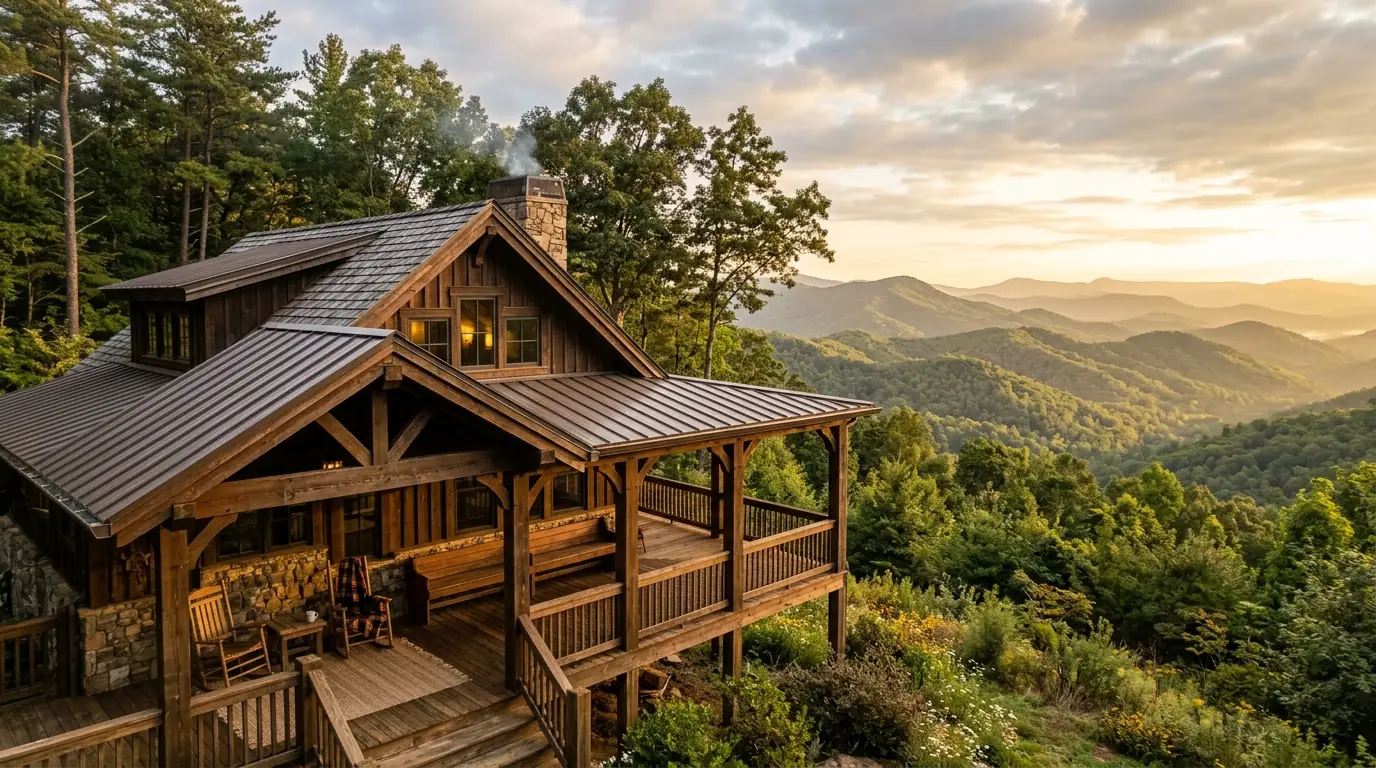
    A covered porch with wooden rocking chairs overlooking rolling blue-green mountain ridges in North Georgia bathed in golden-hour light
    1. Confirm the view at full leafVisit in late spring or summer, or ask for photos taken in full canopy. A winter listing photo taken on a clear day does not confirm a year-round view. Ask the seller directly: does this view exist in August?
    2. Test every utility at the addressRun a speed test from inside the home. Confirm well yield and pressure. Schedule a septic inspection before closing. Check the propane tank ownership terms and current contract. Do not rely on county-level utility descriptions.
    3. Drive the route in wet weatherVisit at least once after rain. Evaluate the driveway grade, drainage, and surface. Check for erosion, washouts, or soft shoulders. Confirm the approach is passable in the conditions you’ll actually face in January and February.
    4. Get an insurance quote before the offerRequest a preliminary homeowner’s insurance quote for the specific address and elevation. Higher-elevation rural properties can carry different rates and coverage limitations than lower-elevation homes in the same county.
    5. Read every deed restriction and easementSome ridgeline communities have covenants restricting tree removal, which could limit your ability to maintain or expand the view over time. Read those documents before assuming you can improve the sight line after purchase.
    Don’t assume mountain means no HOA

    Some of North Georgia’s most scenic ridgeline communities have active homeowners associations with architectural review requirements, tree-removal restrictions, and short-term rental prohibitions. Read the full covenant package, not just the monthly fee, before deciding the rules fit your plans. Covenant language has not been independently verified for this article; request current covenants in writing from the seller.

    How mountain-view homes fit the broader North Georgia market

    A mountain-view search is one filter inside a larger buyer decision. Buyers who want a view-premium property are often also considering the broader North Georgia mountain homes for sale market, which includes properties with mountain character but no standout ridge view. The central question is usually how much the view itself is worth relative to the access and infrastructure trade-offs.

    Budget plays a real role here. A North Georgia budget comparison guide shows how buyer expectations shift between counties and property types at a given price. View-premium properties often reduce the lot size or finish level available at that same budget. Model that before narrowing the search entirely to ridgeline inventory.

    Buyers who value mountain character but want easier access sometimes find a better fit with cabins for sale near Dahlonega, where mountain aesthetics come without always requiring the same elevation and road complexity. Neither direction is automatically better. The right answer depends on how frequently you’ll use the property and what your daily-life access requirements actually are.

    Frequently Asked Questions

    Do mountain-view homes in North Georgia cost significantly more?

    View-premium properties typically price above comparable non-view homes in the same area, but the difference depends on the quality and consistency of the view, the elevation, and current inventory. Compare specific properties with a local agent rather than applying a fixed premium figure.

    What elevation do I need to get a clear mountain view in North Georgia?

    Clear long-range views in the Blue Ridge region often require meaningful elevation, though local topography and tree cover vary by parcel. A property with a south-facing clearing at moderate elevation can still offer views. The only reliable test is a summer visit to the specific property.

    Are mountain-view homes harder to insure?

    Higher-elevation and rural properties can carry different insurance costs and coverage terms. Get a preliminary quote using the exact address before making an offer. Do not rely on rates from lower-elevation comparables in the same county.

    Will the mountain view be the same all year?

    Not always. Many North Georgia mountain views are seasonal — clear in winter and early spring, then partially or fully blocked by canopy from late spring through fall. Ask the seller whether the view exists in full leaf and visit during summer if possible before committing.

    What internet options are available at ridgeline properties?

    Options vary significantly by address. Some areas have fiber or fixed wireless; others depend on satellite internet. Run a speed test at the specific address and confirm upload performance if you plan to work from home. County-level descriptions are not sufficient evidence of service quality.

    Do higher-elevation North Georgia homes use well and septic?

    Most higher-elevation and rural properties in North Georgia use private wells and septic systems. Have the well yield and pressure tested and get a full septic inspection before closing. These systems are the owner’s full responsibility and condition varies widely from property to property.

    Can I remove trees to improve the view after I buy?

    It depends on the deed restrictions, HOA covenants, and local ordinances for the specific property. Some ridgeline communities restrict tree removal or require architectural review. Read the full covenant package before assuming you can modify the landscape to expand the view over time.

    How do I evaluate a mountain driveway before buying?

    Visit after rain. Check the grade, drainage, and surface condition. Ask about maximum slope, surface material, maintenance responsibility, and whether a standard vehicle can navigate it in all seasons. Confirm emergency vehicles can reach the home and have room to turn around.

    Are short-term rentals allowed at mountain-view properties?

    Rules vary by county, municipality, and community covenant. Some ridgeline communities explicitly prohibit short-term rentals. Verify current rules at both the county and HOA level before purchasing with rental income as part of the plan.

    How can Gold Peach Realty help with a mountain-view home search?

    Gold Peach Realty can help you build a search plan around view quality, elevation, access requirements, and county-specific inventory — so the property you offer on reflects what you actually want to own, not just what looked best in the listing photos. Call (770) 283-1223 to start the conversation.

    Ready to search North Georgia mountain-view homes?

    Build a search around the view type, road access, and utility conditions that fit your life, not just the panorama. Call (770) 283-1223 to connect.

    Connect with Gold Peach Realty, your North Georgia mountain home specialists
  • Dawson County Homes for Sale: From GA-400 to the Amicalola Foothills

    Dawson County Homes for Sale: From GA-400 to the Amicalola Foothills

    Quick answer (TL;DR)

    Dawson County gives buyers two distinct search areas: the GA-400 side near Dawsonville for everyday access, and the quieter foothills toward Amicalola Falls for wooded land and mountain character. Start with location, road access, utilities, and deed restrictions before comparing finishes. Those basics can matter more than a polished kitchen.

    Dawson County stretches from the GA-400 corridor into North Georgia foothills. Buyers can compare neighborhood convenience near Dawsonville with more rural settings toward Amicalola Falls, then verify access, utilities, restrictions, and property condition.

    How Dawson County changes from south to north

    A countywide home search is different from a Dawsonville search. Dawsonville is the county seat and the name most buyers see in listing portals, but the mailing address does not tell the whole story. The southern side of the county is shaped by GA-400, retail, and routes toward Forsyth County. Farther north and west, the land becomes more wooded and the roads feel more rural.

    That split gives buyers a practical first decision. Do you want easier access to errands and a regular drive south, or are privacy and a foothill setting higher on the list? Neither choice is automatically better. The right answer depends on how often you need GA-400, whether you are comfortable with longer local roads, and how much property upkeep you want.

    CorridorConvenience and a simpler drive south
    FoothillsWooded settings and mountain character
    CountywideMore choices when the search map stays open
    Start with the map, not the countertops

    Plot the routes you will use on an ordinary weekday. A home that looks close on a map may sit on a winding county road, while another may have a direct path to GA-400. Drive the route before deciding that two properties are equally convenient.

    What buyers can compare across Dawson County

    Dawson County homes for sale can include established neighborhood houses, newer subdivision homes, rural single-family properties, and homes on larger wooded parcels. Inventory changes, so this guide does not promise a current listing count or a fixed price band. It gives you a way to sort what is available today without treating unlike properties as direct substitutes.

    The county view is useful because a buyer can widen or narrow the map without leaving the same general market. Someone who begins near GA-400 may decide that a little more driving is worth a quieter lot. Another buyer may start with acreage and discover that driveway maintenance, internet service, or well and septic responsibilities make a neighborhood home the more comfortable fit.

    Quick area answer

    Choose the GA-400 side when routine access matters most. Look toward the Amicalola foothills when land, trees, and a quieter setting carry more weight. In either area, verify the actual road, utility, and restriction details for the parcel rather than relying on a broad location label.

    Search lensWhat may appealWhat to verify
    GA-400 corridorRegular trips south, nearby services, neighborhood optionsTraffic pattern, subdivision documents, utility providers
    Dawsonville areaCounty-seat access with routes in several directionsCity or county jurisdiction, commute route, future plans nearby
    Amicalola foothillsWooded land, privacy, mountain-road characterDriveway grade, internet, well and septic records, emergency access
    Larger parcelsSpace for gardens, workshops, or outdoor useSurvey, easements, boundaries, maintenance responsibilities

    A practical Dawson County home-search plan

    A broad portal search can become noisy fast. Sort homes by the parts of the purchase that are difficult to change. Location, road access, water source, septic placement, lot shape, and deed restrictions belong at the top of the list. Paint, lighting, and appliances can wait.

    1. Choose your daily-life boundaryMark the routes you expect to use for work, groceries, medical appointments, and regular trips south. Keep the first search inside that realistic boundary.
    2. Separate neighborhood and rural homesCompare each group on its own terms. A rural property may offer more land, while a neighborhood may reduce private-road and utility questions.
    3. Review the property documents earlyAsk for the seller disclosure, survey if available, septic information, well records, covenants, and any road-maintenance agreement before the due-diligence clock becomes tight.
    4. Inspect the hard-to-change featuresPay close attention to drainage, slope, driveway access, retaining structures, foundation movement, roof condition, and signs of water intrusion.
    5. Confirm the offer against current evidenceUse current comparable sales and the condition of the specific property. A countywide average cannot substitute for a property-level analysis.
    Rural-property warning

    Do not assume a visible driveway is fully on the parcel or that every access road is publicly maintained. Confirm access, easements, maintenance obligations, and emergency-vehicle practicality in writing. For private wells and septic systems, use qualified inspectors and review the available records.

    A house can be renovated. Its road, slope, water source, and place on the map are much harder to change.

    How nearby markets help you judge the fit

    Dawson County makes more sense when you compare it with other North Georgia choices. The published guide to homes for sale in Dawsonville focuses on the town and GA-400 access. Buyers who want a more urban service base can compare the Gainesville home-buying guide. Those who prefer a tourism-oriented mountain setting can review homes for sale in Helen.

    Those are not interchangeable markets. The comparison helps reveal what you value. Dawson County often appeals to buyers who want North Georgia terrain without giving up the GA-400 connection. Gainesville offers a larger city environment. Helen has a distinct visitor economy and mountain-town feel. Visit each area on an ordinary day, not only on a weekend outing.

    Local details worth checking before an offer

    Amicalola Falls State Park is a recognizable Dawson County landmark and a useful reference point for the county’s northern foothills. It should not be used as a shortcut for describing a property. A listing can be in the same county and still have a very different drive, elevation, view, or road condition. Verify each parcel on its own.

    Jurisdiction also matters. A Dawsonville mailing address does not automatically tell you whether a property is inside city limits. Confirm the governing jurisdiction, tax record, utility provider, school assignment, zoning, and permitting history through the appropriate public offices. If future construction or subdivision is important to you, ask about zoning and access before assuming a large parcel can be divided.

    For homes in an association, read the current covenants, budget, meeting minutes, architectural rules, and fee schedule. For homes outside an association, check recorded restrictions anyway. No HOA does not mean no deed restrictions. It also means the owner may carry more responsibility for roads, drainage, shared gates, or common infrastructure.

    Frequently Asked Questions

    Where should I start a Dawson County home search?

    Begin with the routes you will use most. If regular travel south matters, start near the GA-400 corridor. If privacy and a foothill setting matter more, expand north and west, then verify road and utility conditions for each property.

    Are Dawson County homes all near Dawsonville?

    No. Dawsonville is the county seat and a common mailing-city label, but the county extends well beyond the town. Use the parcel map and actual driving route instead of judging location from the mailing address alone.

    What kinds of homes are available in Dawson County?

    Buyers may encounter neighborhood houses, newer subdivision homes, rural single-family properties, and homes on wooded parcels. The active mix changes, so review current listings rather than relying on a fixed inventory description.

    Does every Dawson County home have public water and sewer?

    No. Service depends on the exact location. Some properties use private wells and septic systems. Confirm the providers and system type, then inspect private systems with qualified professionals.

    What should I check on a mountain or foothill driveway?

    Look at grade, drainage, surface condition, turnarounds, shared-use terms, and maintenance responsibility. Consider how the driveway works in heavy rain and whether service and emergency vehicles can reach the home safely.

    Do homes in Dawson County have HOA rules?

    Some do and some do not. Request current covenants and association documents for any governed property. Outside an HOA, still check the deed for recorded restrictions, easements, and shared-road obligations.

    How should I compare a rural home with a subdivision home?

    Compare total responsibilities, not just lot size. Rural ownership may involve a well, septic system, private road, or more land maintenance. A subdivision may trade some autonomy for shared standards and services.

    Is Amicalola Falls close to every Dawson County property?

    No. The park is a county landmark, not a description of every address. Check the actual route and travel time from the property, especially when the home sits on rural roads.

    What documents should I ask for before making an offer?

    Ask for the seller disclosure, survey if available, covenants, septic and well records, permits, and any private-road agreement. Your agent and closing attorney can help identify additional documents for the specific property.

    How can Gold Peach Realty help with Dawson County homes for sale?

    Gold Peach Realty can help you define a countywide search, review current listing details, compare locations, and build a property-specific due-diligence plan before you commit.

    Ready to compare Dawson County homes?

    Search the county with a plan built around your routes, property needs, and due-diligence comfort. Call (770) 283-1223 to discuss your search.

    Connect with Gold Peach Realty, your local Dawson County, North Georgia brokerage
  • Homes for Sale in Helen, GA: What Buyers Need to Know About White County’s Market

    Homes for Sale in Helen, GA: What Buyers Need to Know About White County’s Market

    Quick answer (TL;DR)

    Helen is a Bavarian-themed village in White County, northeast of Atlanta. Buyers find in-town cottages, Chattahoochee River cabins, and rural White County acreage. The tourist economy changes the buyer math: vacation-rental potential drives part of the demand here, and buyers evaluating STR income need to verify current city and county ordinances for the specific property before making an offer.

    Helen, Georgia is a small Bavarian-themed city in White County, northeast of Atlanta. The real estate market blends in-town cottages, river cabins, and rural acreage. Tourism plays an outsized role in buyer demand.

    What makes Helen a different kind of North Georgia real estate market

    Most North Georgia towns draw buyers for mountain character, outdoor access, or a quieter alternative to Atlanta suburbs. Helen does all of that and adds something unusual: a functioning tourism economy that runs most of the year.

    The city was reimagined as a Bavarian alpine village in 1969, and that reinvention held. The Chattahoochee River runs through the center of town. It anchors the summer tubing trade. Oktoberfest draws visitors from across the Southeast each fall. That activity level changes what “location” means for a buyer here. An in-town property is not just close to nature trails; it is close to foot traffic, restaurants, and shops that run on tourist timing.

    NE of Atlantavia GA-400 and US-129
    White CountyGPR service area; county seat is Cleveland, GA
    Bavarian VillageTransformed in 1969; architectural character maintained
    Chattahoochee RiverRuns through town; anchor of the summer recreation economy

    For buyers who plan to live full-time, the tourist character is a quality-of-life question: how much seasonal traffic, how far is the grocery store, what does the off-season actually feel like. For buyers evaluating vacation-rental income, it is a central factor that requires current research, not assumptions.

    Property types buyers find in and around Helen

    In-town Helen properties

    Within the city limits, the inventory is small. Helen has a few hundred permanent residents, and the built environment reflects that. Shops, restaurants, and hospitality properties occupy most of the walkable core. Residential properties that come to market inside city limits tend to be older construction, often with the Bavarian architectural detailing the city encourages.

    In-town location carries a premium here for the same reason it does in any tourist destination: walkability and proximity to established foot traffic have value buyers recognize. If rental activity is part of your plan, verify current city zoning and business-license requirements before going under contract.

    River cabins and wooded lots

    Just outside the city, the inventory broadens into cabin-style properties on wooded lots near the Chattahoochee and its tributaries. These range from well-maintained vacation cabins with updated interiors to older log structures that have seen years of rental use.

    Cabin maintenance adds up — budget it from day one

    Log and cabin-style homes need regular refinishing, sealing, and restaining. The cost is meaningful, and the interval is typically every three to five years, depending on exposure and wood condition. A cabin that has been in the vacation-rental rotation for years may have deferred this work. Get an inspection that specifically evaluates the exterior wood condition, and factor any remediation estimate into your offer process before closing.

    River-adjacent properties carry the same due-diligence requirement as any water-proximate property in North Georgia. Get the floodplain designation from FEMA maps, confirm your lender’s flood-insurance requirement, and verify that any structure on the bank is properly permitted.

    Rural White County acreage

    Beyond the immediate Helen area, White County has rural residential inventory on larger parcels: wooded acreage, farmland, and mountain-adjacent properties that do not carry the tourist-area premium of in-town or river-front Helen. The county seat of Cleveland, to the south, has its own inventory base that sometimes offers better price-per-square-foot than Helen-adjacent properties.

    Buyers comparing White County rural options with other GPR service counties can look at the North Georgia homes by budget tier guide, which covers what different price ranges typically yield across counties.

    The tourist-economy premium on in-town Helen properties fades quickly as you move a few miles out into White County, where rural inventory often runs at lower price-per-square-foot.

    Short-term rental considerations in Helen

    Quick answer

    Helen’s tourism economy draws buyers evaluating short-term rental income. Whether a specific property can legally operate as an STR depends on its location inside city limits versus unincorporated White County, any applicable HOA covenants, and current ordinances. All of those can change. Verify the rules for the specific parcel with the city or county before purchasing.

    Many buyers who approach the Helen market are thinking about short-term rental income alongside the purchase. That calculation is reasonable given the area’s established tourism draw. But it only works if you verify the current legal framework for the specific property before going under contract.

    • City of Helen vs. White County: properties inside city limits and those in unincorporated White County operate under different rules. STR regulations, business license requirements, and permitted uses differ between the two jurisdictions.
    • HOA restrictions: some communities and subdivisions near Helen have covenants that limit or prohibit short-term rentals regardless of city or county rules. Request the full covenant documents and confirm the current enforcement posture with the HOA board directly.
    • Ordinance changes: tourism towns revisit their STR rules regularly. An ordinance that was permissive when a neighbor purchased may have tightened since. Pull the current code from the City of Helen or White County Planning and Zoning. Do not rely on what the listing agent or a prior owner says is permitted.

    Verify STR rules for the specific parcel before making an offer

    Purchasing a Helen-area property on the assumption that short-term rental income will service the mortgage, without verifying current city and county ordinances, is one of the more common buyer mistakes in tourist-market real estate. The verification takes a phone call or a visit to the planning office. Do it before you are under contract, not after.

    Seasonality and what it means for buyers

    Helen’s market has seasonal patterns that most North Georgia markets do not. Foot traffic peaks in summer during tubing season on the Chattahoochee, and again in fall during Oktoberfest and apple harvest season in the surrounding mountains. The off-season is quieter.

    For buyers looking at vacation properties, that seasonal curve runs in two directions. Rental income potential is skewed toward the high-season months; an annual income projection that assumes uniform occupancy will be optimistic. Also, touring a property in peak season gives you a full picture of what traffic and noise look like at the busiest times. Touring in January tells you what the off-season character feels like. Both are useful, and neither alone tells the whole story.

    For full-time residents, the seasonal swing is mostly a community-character question. Helen’s permanent population is small, and the city takes on a different feel when visitor traffic drops after October.

    White County basics for home buyers

    Property taxes

    White County property tax rates are set by the county and city separately. For any specific parcel you are considering, verify the current millage rate and assessed value with the White County Tax Assessor. Rates differ between city-incorporated and unincorporated parcels, so confirm which jurisdiction applies to the address you are buying.

    Schools

    White County Schools operates the public school system. Verify the current attendance zone for any specific parcel. Zone maps are available from the district; confirm directly rather than assuming by zip code.

    Comparing to neighboring counties

    White County sits between Lumpkin County to the west, where Dahlonega is the county seat, and Habersham County to the east. GA-400 to the west connects toward Dawson County. Buyers comparing those markets can look at the homes for sale in Dawsonville guide, which covers the GA-400 corridor at the lake’s southern end.

    For Lumpkin County specifically, the houses for sale in Lumpkin County guide covers the Dahlonega-area market that borders White County on the west side. And for buyers working out what a specific budget gets across the region, the what your budget buys in North Georgia guide looks at that question county by county.

    Steps to start your Helen home search

    1. Decide whether you are buying a residence or a vacation property. The due-diligence lists are different. Full-time buyers focus on school zones, commute, and community services. Vacation-property buyers need to verify STR rules, HOA covenants, and rental history before getting attached to a listing.
    2. Get pre-approved before you tour. Helen-area properties that are well-priced or recently updated can move quickly, particularly vacation properties listed heading into spring. A pre-approval from a lender who has verified income and credit puts you in a position to move when you find the right property.
    3. Verify STR rules for every property on your list. For any property you are considering as a vacation rental, call the City of Helen or White County Planning and Zoning and confirm the current rules for that specific address. Do this before the first showing, not after.
    4. Budget cabin maintenance from day one. If cabin or log-construction properties are on your list, build the inspection and a maintenance-cost estimate into your process early. Deferred exterior maintenance on a cabin that has been in heavy rental rotation is a predictable issue. Find it before closing.
    5. Work with an agent who knows the White County and Helen market specifically. The tourist-economy dynamics here differ from other North Georgia markets. An agent who works this area regularly knows the STR rule history, the HOA covenants that create common problems, and what realistic seasonal rental projections look like.

    Frequently Asked Questions

    What types of homes are for sale in Helen, GA?

    In and around Helen, buyers find in-town cottages and Bavarian-style properties within city limits, cabin-style homes on wooded lots near the Chattahoochee River and its tributaries, and rural single-family and acreage properties throughout White County. The inventory within the city itself is small. Most active listings are in the surrounding areas.

    Can you buy a short-term rental property in Helen, GA?

    It depends on the specific property’s jurisdiction, zoning, and any applicable HOA covenants. The City of Helen and White County have different rules, and those rules change over time. Verify current STR ordinances and business license requirements directly with the City of Helen or White County Planning and Zoning for any property you are considering. Do not rely on what a neighbor or listing agent says is permitted.

    How far is Helen, GA from Atlanta?

    Helen is northeast of Atlanta. The most common route runs north on GA-400 through Dahlonega and then east on US-129 / GA-75. Drive times depend on Atlanta-area traffic and your starting point.

    What is Helen, GA known for in real estate?

    Helen’s real estate market is shaped by its Bavarian village character, which the city has maintained since a 1969 redesign, and by the Chattahoochee River running through town. The summer tubing economy and Oktoberfest in the fall create tourism demand that makes vacation-rental potential a real factor in buyer decision-making. That separates it from most other North Georgia markets.

    What is the White County property tax situation for home buyers?

    White County property taxes are assessed at millage rates set separately by the county and city. The rate for any specific property depends on whether it sits inside city limits or in unincorporated White County. Verify the current millage rate and any applicable exemptions with the White County Tax Assessor before closing.

    Are there HOA communities near Helen, GA?

    Some subdivisions and communities near Helen operate with HOAs, which may restrict short-term rental activity. Not all properties in the area are in HOA communities. Many rural and cabin properties are not. For any property with an HOA, request the full covenants and the most recent meeting minutes as part of your due diligence.

    What outdoor recreation is near Helen for home buyers to consider?

    The immediate area has Unicoi State Park, Anna Ruby Falls within Unicoi, Appalachian Trail trailheads in the Chattahoochee National Forest, tubing on the Chattahoochee River, and multiple hiking corridors in the surrounding Blue Ridge mountains. The area offers some of the most accessible mountain recreation in North Georgia.

    How does Helen, GA compare to buying in Dahlonega?

    Dahlonega (Lumpkin County) and Helen (White County) are both mountain towns with tourism economies, but the character differs. Dahlonega is the county seat with a UNG campus presence, Gold Rush history, and a growing winery corridor. Helen is smaller, more tourist-oriented, and draws the Bavarian/Oktoberfest visitor base. Buyers who prioritize college-town proximity tend toward Dahlonega. Buyers drawn to the river and the tourism economy often look at both.

    What are log homes like to maintain in the Helen area?

    Log homes and cabin-style construction need regular exterior maintenance. Refinishing, sealing, and restaining is not cheap, and you should expect to do it every three to five years depending on the size of the structure and its exposure. Cabins that have been in heavy vacation-rental use may have deferred this work. A thorough inspection should specifically evaluate the exterior wood condition and when sealing or staining was last done.

    Is Helen, GA a good place to buy a vacation home?

    Helen’s established tourism economy makes it a real market for vacation-property buyers. Whether it is the right purchase depends on verifying the STR rules for the specific property, understanding the seasonal income curve (summer and fall are the strongest seasons), budgeting realistically for cabin maintenance, and comparing net-income projections against current purchase prices. Do that analysis before you fall in love with a listing.

    Are there new construction homes near Helen, GA?

    New construction near Helen exists but is not the dominant inventory segment. Most listings in the area are existing single-family homes, cabins, and older in-town properties. White County has seen some construction activity, particularly in the county’s more accessible suburban corridors rather than within Helen itself. Check current active listings with an agent for an up-to-date picture.

    What is the Chattahoochee River’s role in the Helen real estate market?

    The Chattahoochee runs through the center of Helen, and river access and adjacency carry a premium in this market. Tubing is a major summer draw, and the river matters for lifestyle and views beyond just the rental income angle. Properties directly on or adjacent to the river have different price dynamics and different due-diligence requirements. Verify floodplain designation and any structure-permitting requirements for water-adjacent properties before purchase.

    Ready to search homes in Helen and White County?

    Gold Peach Realty works with buyers across White County, Helen, and the broader North Georgia market. Call (770) 283-1223 to talk through your search.

    Get a free home valuation from Gold Peach Realty
  • Buying a Home in Gainesville, GA: What the Hall County Market Looks Like

    Buying a Home in Gainesville, GA: What the Hall County Market Looks Like

    Quick answer (TL;DR)

    Gainesville is Hall County’s largest city, northeast of Atlanta on I-985. Single-family homes span older in-town neighborhoods, newer subdivision corridors, and Lake Lanier-adjacent parcels. Prices have generally run below comparable Atlanta suburbs, and the local economy draws from healthcare, manufacturing, and distribution, which gives the market more staying power than most single-source North Georgia towns.

    Gainesville, Georgia sits northeast of Atlanta in Hall County. Single-family homes span in-town neighborhoods, newer subdivisions, and Lake Lanier-adjacent parcels. Northeast Georgia Medical Center anchors the local economy. Buyers here typically find more inventory than in smaller mountain towns.

    What Hall County looks like for a home buyer

    Gainesville is the county seat of Hall County, one of Georgia’s faster-growing counties over the past two decades. The broader Hall County market extends well beyond city limits into suburban and rural corridors that significantly expand the available inventory.

    That geography matters to buyers, because “Gainesville” covers three distinct zones:

    • In-town neighborhoods: older construction from the 1950s through the 1980s, closer to the city center and downtown square. Smaller lots, established trees, shorter drives to county services.
    • Suburban subdivision corridors: newer builds along Hwy 129 toward Cleveland and the Hwy 53 crossroads zones. This is where most recent single-family construction has landed.
    • Lake-adjacent properties: parcels near Lake Lanier’s northern arm. True lakefront, lake-access communities with shared dock rights, and lake-view homes each carry different price points and different due-diligence requirements.
    NE of Atlantavia I-985 and I-85
    Hall County seatLargest city and services hub in the area
    Lake LanierNorthern arm borders Hall County
    UNG campusUniversity of North Georgia in Gainesville

    What single-family buyers actually find on the market

    Prices in Gainesville and Hall County have historically run below Atlanta suburbs of comparable size, though that gap has narrowed as in-migration from the metro picked up. Rather than quote figures that will be outdated by the time you read this, here is how the market has generally broken down by segment:

    • Starter homes in the lower price tiers have thinned in recent years (verify with current MLS comps).
    • Suburban three- and four-bedroom homes on subdivision lots have been the most active tier in Hall County for single-family buyers.
    • Lake-access and lakefront properties run well above subdivision pricing, with premiums that depend on water depth, permitted dock status, and Army Corps compliance.

    If you’ve looked at Lumpkin County home inventory and found limited supply at your price point, Hall County usually offers more active listings across most tiers.

    Pull county-level comps, not just city-level

    Gainesville city limits and Hall County unincorporated areas show meaningfully different price distributions. Ask your agent to pull both separately, and confirm school district attendance zones by parcel. A home just outside city limits can fall into a different school cluster than one two streets over inside city boundaries.

    What drives real estate demand here

    Most North Georgia markets draw from one demand source. Gainesville draws from several, which makes a real difference when the market cycles.

    Northeast Georgia Medical Center

    The health system is one of the biggest employers in northeast Georgia. Healthcare employment trends more stable than retail or hospitality, and it draws professionals who need housing within reasonable commuting distance. That buyer pool doesn’t disappear when the broader economy softens.

    Poultry processing and food manufacturing

    Gainesville’s “Chicken Capital of the World” reputation reflects real economic activity. Food processing and related manufacturing remain a substantial base in Hall County. The distribution and logistics sector along the I-985 corridor has also expanded, adding jobs that support the local housing market from the workforce end.

    I-985 access to the Atlanta metro

    Gainesville sits at the top of I-985, which runs south to I-85 and into the northern Atlanta suburbs and Gwinnett County. Buyers who work in that corridor sometimes choose Gainesville for more home per dollar. That demand layer runs separately from the healthcare and manufacturing sectors, so no single driver holds the whole market.

    In most North Georgia markets, demand comes from one source. Gainesville has several running at the same time, and that tends to make the market more durable through cycles.

    Lake Lanier: what buyers near the water need to know

    Quick answer

    True lakefront on Lake Lanier requires an Army Corps of Engineers permit for any dock or water structure. Those permits transfer with the property but must be verified before purchase. The difference between actual lakefront, a lake-access community with shared dock rights, and a lake-view home without water access is significant in both price and experience.

    Verify Army Corps permit status before going under contract

    Lake Lanier’s shoreline is managed by the U.S. Army Corps of Engineers, Savannah District. Any dock, pier, boat ramp, or water structure requires a valid Corps permit. Unpermitted structures are common on the lake and create legal and insurance complications. Request active permit documentation from the seller and verify it directly with the Corps as part of due diligence.

    For buyers who want boating access without lakefront pricing, lake-access communities exist where residents share a community dock or boat ramp through an HOA. Lake-view homes without direct water access sit at a lower tier, with sightlines that vary considerably by elevation and tree cover.

    If you’re comparing lake-adjacent options across counties, the homes in Dawsonville guide covers the GA-400 corridor at the lake’s southern end, which shares some buyer dynamics with the Gainesville-area market.

    Gainesville vs. other North Georgia markets

    FactorGainesville / Hall CountySmaller mountain towns
    Inventory sizeLarger, more active listings week to weekSmaller pools, more competitive on desirable homes
    City characterMid-size city with suburban corridorsSmall-town or mountain village scale
    Employment baseHealthcare, manufacturing, distributionTourism, small business, retiree spending
    Water accessLake Lanier (Army Corps permits required for structures)Mountain streams and rivers
    Atlanta highway linkDirect via I-985 to I-85Longer drive, no direct interstate route

    A budget that feels tight in smaller mountain towns sometimes goes further in Hall County, or vice versa depending on property type. The North Georgia homes by budget tier guide covers what each price range looks like across different counties.

    Steps to start your Gainesville home search

    1. Get a pre-approval, not a pre-qualification. Hall County moves quickly on homes in the mid-price tiers. A pre-approval from a lender who has pulled your credit and verified your income lets you move when you find the right property.
    2. Decide which zone fits your priorities before you start touring. In-town Gainesville, the suburban corridors, and lake-adjacent properties have different price profiles, commute patterns, and trade-offs. Getting clear on that before the first showing saves significant time.
    3. Verify school attendance zones by parcel, not by zip code. Hall County school zones don’t map cleanly to city or zip boundaries. Check the specific parcel on the Hall County Schools zone map before you tour, not after.
    4. Add Army Corps permit review to your lakefront checklist. If lakefront or lake-access is part of your criteria, build permit verification into your process from day one.
    5. Work with an agent who focuses on Hall County specifically. An agent who works this market regularly can pull comps by sub-area, flag Corps permit issues, and tell you whether a home is priced right in current conditions.

    Frequently Asked Questions

    Is Gainesville, GA a good place to buy a home?

    For buyers who want North Georgia location with city-level employment, highway access to Atlanta, and a full range of amenities, Gainesville works well. It has more inventory than smaller mountain towns and an economy diversified enough to sustain demand through cycles.

    How far is Gainesville from Atlanta?

    Gainesville sits northeast of Atlanta. Drive times via I-985 and I-85 depend on destination within Atlanta and time of day. Commutes to Gwinnett County and the northern suburbs run shorter than trips into the city core.

    What types of homes are most common in Hall County?

    Single-family detached homes dominate Hall County’s residential inventory. The mix includes older in-town construction from the 1950s through the 1980s, established 1990s and 2000s-era subdivisions, and newer builds in the county’s growing corridors. Condos and townhomes are a smaller share of total inventory.

    What are home prices like in Gainesville compared to Atlanta?

    Prices have historically run below comparable Atlanta suburbs, though that gap has narrowed over the past several years. For current figures, pull active Hall County comps from an agent or a recent MLS report. Advertised price ranges on consumer sites can lag the market by weeks.

    Are Hall County schools good for families?

    Hall County Schools operates a county-wide system with multiple elementary, middle, and high school options. Verify current ratings at GreatSchools.org and confirm the attendance zone for any specific parcel you’re considering, since zones don’t align neatly with zip codes or city boundaries.

    Can I find homes near Lake Lanier in Gainesville?

    Yes. The northern arm of Lake Lanier borders Hall County, and lakefront, lake-access, and lake-view homes all exist within the Gainesville market area. True lakefront is the most expensive category. Lake-access communities with shared dock rights sit in the middle. Lake-view homes without water access are the most affordable tier, with sightlines that vary considerably by property.

    What do I need to know about Army Corps permits for Lake Lanier?

    The U.S. Army Corps of Engineers, Savannah District, manages Lake Lanier’s shoreline. Any dock, pier, or water structure requires a valid Corps permit. Permits transfer with the property but must be verified before purchase. Request active permit documentation from the seller and confirm it with the Corps before closing on any lakefront property.

    What is the biggest employer in Gainesville, GA?

    Northeast Georgia Medical Center is widely recognized as one of the largest employers in the area. The food processing and manufacturing sector, along with a growing distribution and logistics base along the I-985 corridor, also account for a significant share of Hall County employment.

    How does buying in Gainesville compare to buying in Dahlonega?

    Gainesville offers more inventory, larger city infrastructure, a bigger employer base, and a direct highway link to Atlanta. Dahlonega has a small mountain-town character, less inventory, and appeal tied to outdoor recreation. Price per square foot isn’t always directly comparable because the product mix differs significantly between the two markets.

    Are there first-time buyer programs in Gainesville, GA?

    Georgia Dream, administered by the Georgia Department of Community Affairs, offers down-payment assistance for eligible first-time buyers across Georgia including Hall County. Income and purchase price limits apply and change periodically. Verify current eligibility requirements at the Georgia DCA website before counting on this as part of your budget.

    Ready to search Hall County homes?

    Gold Peach Realty works with buyers across Gainesville and Hall County, from in-town neighborhoods to lake-access properties. Call (770) 283-1223 to talk through your search.

    View new Gainesville, Hall County, North Georgia listings at Gold Peach Realty
  • Homes for Sale in Dawsonville, GA: GA-400 Access Without Metro Prices

    Homes for Sale in Dawsonville, GA: GA-400 Access Without Metro Prices

    Quick answer (TL;DR)

    Dawsonville sits at the northern end of the GA-400 corridor in Dawson County, north of Atlanta. Single-family homes here typically run below comparable Atlanta suburbs on price, and buyers get more land and newer builds, often within easy reach of Amicalola Falls State Park and the southern Appalachian Trail gateway. The market stays active. If you want North Georgia real estate without deep mountain isolation, Dawsonville is worth a close look.

    Dawsonville, Georgia sits north of Atlanta on GA-400, with single-family home prices below comparable Atlanta suburbs. Buyers find Dawson County schools, interstate access, and open lots. Demand from commuters and retirees has stayed steady.

    What sets Dawsonville apart from other North Georgia towns

    Dawsonville is the county seat of Dawson County, one of the four counties in Gold Peach Realty’s North Georgia service area. Unlike Dahlonega, which sits at higher elevation with a mountain-town character that shapes everything from home styles to the commute, Dawsonville occupies the transition zone between the foothills and the upper GA-400 suburban corridor. That’s its main selling point and its main trade-off.

    The town is probably best known for the Outlet Shoppes of Atlanta, one of the state’s larger outlet centers, and for access to Amicalola Falls State Park, Georgia’s highest waterfall and the southern gateway to the Appalachian Trail. Both matter for buyers who think about daily quality of life beyond the commute calculation.

    Dawsonville is not a remote mountain retreat. Buyers looking for deep forest isolation or properties measured in dozens of acres should look at other Dawson County listings or areas further north. Most buyers who choose Dawsonville are solving for two things: reasonable distance to Atlanta and access to outdoor space without going fully rural.

    The Dawsonville housing market: what buyers need to know

    Single-family home prices in Dawsonville have moved through a wide range in recent years. Entry-level homes are typically older builds or sit on smaller lots, while larger or newer builds sit at the top of the local range. Treat these as general ranges, not real-time data. Verify current pricing with a licensed North Georgia agent using live MLS data before any offer-price decision.

    Days on market in Dawson County have run tighter than the national average during active buying seasons, spring through early fall. Well-priced homes close to GA-400 in good condition can attract multiple offers. What’s actually moving right now depends on the week and the price tier.

    Property taxes in Dawson County are set by the county tax assessor and can change with reassessment cycles. Buyers should confirm the current millage rate and the specific parcel’s assessed value directly with the county. Tax history figures on a listing’s MLS sheet can differ from what a new owner pays after reassessment at sale.

    Types of homes you’ll find in Dawsonville

    Single-family detached homes make up most of the residential inventory in Dawsonville. The market breaks into a few distinct pockets.

    • GA-400 corridor subdivisions: planned neighborhoods built mostly in the 2000s and 2010s, typically brick-front or hardiplank construction on quarter-acre to half-acre lots, often with HOA amenities like pools and tennis courts. These tend to be the most liquid part of the market.
    • Rural route and county road properties: older farmhouses and ranch-style homes on larger parcels, often without HOA. Condition varies; budget for a thorough inspection.
    • New construction: several builders have had active phases in Dawson County. For a current look at new construction homes in North Georgia, builders and available phases change regularly.
    • Lake-adjacent properties: a small number of homes sit near Corps of Engineers impoundments in the county. Army Corps dock permit requirements apply; confirm current rules before assuming any waterfront access.

    Buyers looking for townhomes or condos in the Dawsonville area are in a separate market segment. This guide covers single-family homes only.

    GA-400 and the commute

    GA-400 ends at an interchange just north of Dawsonville. For many buyers, that’s the whole appeal: a direct interstate connection south toward Alpharetta, Roswell, and Atlanta without the surface-road detour that defines commutes from other mountain-area towns.

    Drive times from Dawsonville to Atlanta’s northern suburbs vary with traffic. During peak commute hours or holiday weekends, it runs longer. Anyone making a serious decision based on commute time should do multiple test drives at the actual times that matter for their schedule. Mapping apps give a general picture; real-world variation is significant.

    For buyers comparing Dawsonville with other towns in the region, the North Georgia where-to-buy guide walks through the trade-offs by county and town, including how commute time and home prices interact across the different markets.

    Schools and daily life in Dawson County

    Dawson County operates a unified school system serving all public school students in the county. Families should verify school zone assignments for specific parcels before purchase. Zone lines can shift, and not all neighborhoods in the county feed the same schools. The Georgia Department of Education and the Dawson County School System website are the current sources for enrollment numbers, test performance data, and zone maps. This article does not reproduce scores or ratings that can change after publication.

    For daily errands, Dawsonville has grocery stores, home improvement retail, medical facilities, and the outlet center. More specialized services typically mean a run south on GA-400 toward Gainesville or Cumming.

    Outdoor access is a concrete part of daily life here. Amicalola Falls State Park, with Georgia’s highest waterfall and the southern Appalachian Trail approach, sits inside Dawson County. For buyers who want that access built into their routine rather than saved for a special trip, the proximity is real and close.

    What different price points get you in Dawsonville

    Budget ranges move with the market. Confirm what’s available now with a licensed agent. These are general patterns from recent activity.

    Price tierWhat buyers typically findWatch for
    Entry-levelOlder ranch-style builds; smaller lots or rural locations; likely needs updatesBudget for inspection and repair costs before committing
    Mid-rangePlanned subdivision homes; some with HOA amenitiesVerify HOA fees and any pending special assessments
    Upper-midNewer builds, larger lots, updated kitchens and baths; some new construction phasesBuilder warranties vary widely; read the full contract terms before signing
    Top tierCustom builds, acreage, or premium lots; less common near Dawsonville’s coreFewer comparable sales; appraisal risk is real at this tier in smaller markets

    For county-level coverage beyond the Dawsonville city limits, the Dawson County homes for sale guide covers inventory across the full county, including the Amicalola foothills corridor to the north.

    Steps to buying a home in Dawsonville

    The purchase process in Dawson County follows standard Georgia real estate contract law. A few things that matter specifically in this market:

    • Get pre-approved before touring seriously. Sellers in Dawsonville’s mid-tier range expect a pre-approval letter, not just a pre-qualification. Offers without one don’t land well.
    • Build in inspection time. Georgia’s standard contracts include an inspection period. Don’t waive it, even on newer builds. Septic, well water on rural properties, HVAC, and foundation grading each warrant their own specialists.
    • Know whether the property is on septic or sewer. A significant number of Dawsonville addresses are not on municipal sewer. Septic inspection is separate from the general home inspection and worth the extra cost.
    • Check the flood zone. Some Dawson County parcels near creek corridors carry FEMA flood zone designations. A licensed surveyor can confirm the specific parcel’s status before closing.
    • Read the full HOA documents. Subdivision homes often carry covenants, monthly fees, and rental restrictions. Read all of it before contract ratification, not just the summary sheet.

    Frequently Asked Questions

    How far is Dawsonville from Atlanta?

    Dawsonville sits north of Atlanta via GA-400. Drive times vary with traffic, and peak hours and holiday weekends run longer. Test drives at your actual commute times are worth doing before making a purchase decision.

    What is the typical home price range in Dawsonville, GA?

    Single-family prices span a wide range: entry-level homes tend to be older or smaller, and larger or newer builds sit at the top of the local range. These ranges shift with market conditions. Confirm current pricing with a licensed North Georgia agent using live MLS data.

    Is Dawsonville a good place to buy a home?

    It works well for buyers who want North Georgia lifestyle, interstate access, and prices below comparable Atlanta suburbs. Buyers looking for deep mountain isolation or lakefront properties should look further north or toward Hall County. Demand has stayed steady, which is a reasonable market signal.

    What county is Dawsonville in?

    Dawsonville is the county seat of Dawson County, Georgia. Most addresses in the city fall within Dawson County’s school district, tax structure, and zoning, though parcel-level verification is worth doing before any purchase decision.

    Are there new construction homes in Dawsonville, GA?

    Several builders have had active phases in Dawson County, and new subdivisions have come to market in recent years. Availability changes fast; some phases sell out within months. A local agent with current builder relationships can tell you what’s available and on what contract terms. Builder contracts differ significantly from resale contracts.

    What are property taxes like in Dawson County?

    Property tax rates are set by the county and subject to reassessment cycles. Contact the Dawson County Tax Assessor’s office or your closing attorney for current millage rates and an estimate for a specific parcel. Historical tax figures on a listing’s MLS sheet may not reflect what a new owner pays after reassessment at sale.

    Do Dawsonville homes have HOAs?

    Some do, particularly the planned subdivisions built along the GA-400 corridor in the 2000s and 2010s. Rural and older homes typically don’t. HOA fees, restrictions, and financial health vary widely. Request and read the full HOA documents before ratifying a contract on any HOA-governed property.

    Is Dawsonville on city water and sewer?

    It depends on the specific property. Newer subdivisions connect to county water and sewer, but rural addresses may be on well and septic. Ask for utility confirmation in the seller’s disclosure and have a licensed inspector evaluate any private well or septic system before closing.

    What outdoor activities are near Dawsonville?

    Amicalola Falls State Park is inside Dawson County. It has Georgia’s highest waterfall, a lodge, and the southern approach to the Appalachian Trail. Additional hiking, fishing, and boating options are within a reasonable drive at state parks and Corps of Engineers recreation areas in the region.

    How long do homes stay on the market in Dawsonville?

    It varies by season, price tier, and condition. Well-priced, move-in-ready homes in popular subdivisions have historically moved quickly during spring and summer. Overpriced homes or those needing significant work sit longer. A local agent with current Dawson County absorption data can give you an accurate picture for the current month.

    Can I find entry-level homes in Dawsonville?

    They appear, but tend to be older, smaller, or needing updates. The entry-level tier shrinks when demand is active.

    How do Dawsonville home prices compare to Atlanta suburbs?

    Dawsonville generally offers more square footage and land per dollar than comparable northern Atlanta suburbs like Alpharetta or Milton. The trade-off is a longer commute and fewer nearby amenities. For buyers who put space and North Georgia access above urban walkability, the comparison usually lands in Dawsonville’s favor, but any comparison should use current MLS data rather than general estimates.

    What should I look for in a Dawsonville home inspection?

    Beyond the general inspection: HVAC systems (age and condition matter given North Georgia’s seasonal temperature swings), crawl space moisture, septic systems on non-sewer properties, well water quality where applicable, and foundation grading on sloped lots. Hire licensed specialty inspectors for each system, not just the general inspector.

    See current Dawsonville, North Georgia listings at Gold Peach Realty, your local North Georgia brokerage serving Dawson, Lumpkin, Hall, and White counties. Call (770) 283-1223 to speak with a licensed agent who knows this market.